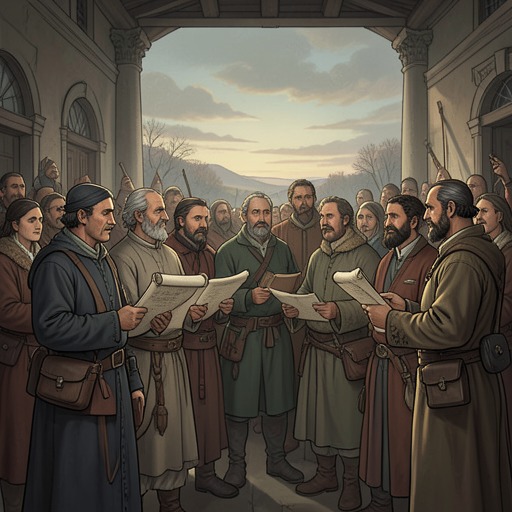
Providence and the Worldwide Spread of the Gospel
Book of EstherProvidence and the Worldwide Spread of the Gospel is the book’s account of how religious proclamation depends on an extended history of political change, material technologies, communication, and organized effort. The author interprets these developments as a connected providential chain: means created or revived for ordinary purposes become means of making Scripture accessible and carrying it across the world. This account rests on a distinction that also shapes the book’s reading of Esther: God may direct events toward an intended end without removing the responsibility of the human agents whose actions serve that end.
Providence and Human Agency
The argument begins from the book’s account of Esther’s rise and the danger facing the Jews. The author treats the circumstances that brought Esther to the Persian throne as providentially ordered toward their deliverance, while also judging the human conduct involved by the moral law. He argues that God’s purpose can be accomplished through voluntary actions, including actions that are sinful; their usefulness to that purpose does not make the agents innocent. The same distinction governs his wider interpretation of history. Political rulers and other human actors may pursue their own ends, or oppose God, yet their actions can still be made to serve a purpose they do not recognize.
This view is offered not as a philosophical explanation that resolves the apparent conflict between divine sovereignty and human freedom, but as a scriptural claim that people should receive even when they cannot comprehend it. The author rejects the idea that human responsibility must disappear if events fall within divine appointment. In his account, the two claims stand together: people are accountable for their conduct, while God’s government is not defeated by their opposition. The history of the gospel’s spread thus becomes evidence, in the author’s interpretation, that events which appear disconnected or even hostile can contribute to a larger design.
Scripture, Materials, and Reproduction
The author traces the gospel’s material reach first through the preservation and multiplication of Scripture. He treats the survival of the Bible through the Church of Rome as a striking instance of providence, while explicitly denying that this church was the only means of preservation: Eastern churches and groups outside the Western church, he argues, could have preserved Scripture even if copies held by the Church of Rome had been destroyed. His point is that the Bible passed through an institution he regards as hostile to its authority, yet emerged intact enough to bear witness against that institution. The transmission itself, in this reading, becomes part of the case for the text’s preservation.
Papermaking altered the practical conditions of access. The book dates its invention to the eleventh century and contrasts it with the earlier scarcity of writing materials. After the conquest of Egypt by the Saracens in the seventh century, the author says, the interruption of communication with Egypt made papyrus unavailable in Europe, leaving parchment as the writing material. Books became costly and scarce: monasteries could lack complete works, and the author cites the purchase of a collection of homilies for two hundred sheep, alongside quantities of wheat, rye, and millet. He argues that without cheaper writing material, Scripture could not have become widely available to ordinary households or travelled broadly among nations.
Paper alone did not make books broadly affordable. As long as texts had to be copied by hand, their cost remained beyond the reach of much of society. The author notes that writing out a Bible could cost as much as building an ordinary country church, and that in 1471 Louis XI had to pledge valuable plate and provide a nobleman as security to borrow a book. Printing, first using carved wooden blocks and later movable type, supplied the further change: it made large-scale multiplication possible. The book places the early development of printing in Germany or Flanders around 1420, its movable-type improvement about thirty years later, and its subsequent refinement in France. It presents the combination of paper and printing as a timely precondition for the Reformation and for the later era of Bible societies.
Reading and the Communication of Ideas
Reproduction required readers as well as books. The author describes the Dark Ages as a period of widespread illiteracy, noting that even people of high rank and some clergy could not read adequately. He uses the example of an English Bible edition of six hundred copies that took more than three years to sell, despite legal incentives that rewarded the ability to read. Against this background, the growth of education and reading appears in his account as another condition for Scripture’s wider circulation. He connects schools and educational societies to the eventual capacity of people to read the Bible, while observing that efforts begun for other purposes could contribute to that result.
Writing and literacy also enable the interpretation and discussion of Scripture across distance. In the author’s view, written communication lets Christians teach, correct, exhort, and exchange interpretations without having to meet in person. This can help readers understand revelation and answer errors; it can also circulate error. He does not treat that danger as cancelling the benefit. Instead, he argues that the need to answer distortions can deepen understanding of Scripture and expose the limits of human judgment. Thus the means of communication carry competing ideas, but their capacity to transmit religious teaching remains central to the account.
Navigation, Commerce, and Worldwide Reach
For the gospel to reach distant peoples, the book argues, printed texts and readers were not enough: routes and transport had to connect them. The mariner’s compass is presented as a decisive instrument because it made navigation across open water more practicable. Before its use, sailors relied on the sun and stars and generally kept within sight of land; long voyages followed coasts slowly and at risk. The compass, according to the author, enabled ships to cross the ocean and reach scattered islands, helping make the worldwide proclamation of the gospel feasible. He links the magnet’s properties, their discovery and practical application, and the later expansion of navigation as stages in one providential sequence.
Commerce supplies the continuing network that discovery alone could not provide. The author recalls how the fragmentation of Europe after the irruptions of northern peoples restricted intercourse between territories and obstructed trade. He then argues that commercial shipping, capital, and established routes provide transportation that missionary and Bible societies could not feasibly fund on their own. Commerce carries Bibles to distant ports and helps distribute them within countries; roads, canals, mail coaches, steamships, and railways extend this movement over land and sea. In this account, transport systems built for commercial purposes can also carry religious texts and workers, even though their operators need not share that purpose.
Institutions and the Historical Conclusion
The final links in the chain are organized educational and missionary efforts. The author points to the growth of missionary, Bible, and education societies during the preceding half-century as evidence that Christians across denominations had become newly active in seeking wider religious instruction and conversion. He contrasts this cooperation with earlier periods, when concern for a denomination’s particular interests could outweigh shared efforts. In his reading, collaboration around Bible distribution demonstrates a broader movement toward proclaiming the gospel, without requiring participants to abandon their religious principles.
Across the argument, Providence and the Worldwide Spread of the Gospel joins events and mechanisms that operate on different scales: the preservation of a text, the cost of a book, a person’s ability to read, a ship’s passage across open water, and the organization of societies. The author interprets their accumulated effect as the historical fulfilment of the prediction that the gospel would be proclaimed among all nations. He presents that conclusion as the endpoint of a chain extending over eighteen hundred years, not as the product of one invention or institution. The chain’s significance lies in the contrast between the limited aims of many human agents and the worldwide religious outcome the author believes their actions and circumstances have served.